By Omar Ayoub, owner, Aided Water Damage Restoration
A sewage backup is one of the worst calls I get. This isn’t a mess you clean up with paper towels and a strong stomach. Raw sewage carries bacteria and pathogens that can genuinely make your family sick. So before you grab a mop, let me tell you what’s actually happening and how I’d handle it.
Here’s the short version of who you’re calling. I’m the one who answers the phone, day or night, and I’m the one who shows up. Aided Water Damage Restoration is local, licensed, and insured. No call center. No third-party subs I’ve never met. Just me and my crew. You can read what people have said about working with us on our Google profile.
It’s a health problem first, a plumbing problem second
It’s tempting to treat a backup like a clogged drain. It isn’t. The water that comes up through a floor drain or toilet carries E. coli, viruses, and parasites. That’s the part people underestimate.
The bigger issue is what you can’t see. Even after the visible mess is gone, contamination soaks into porous stuff like drywall, carpet, insulation, and wood framing. That’s why real cleanup isn’t just pumping out water. It’s making sure what’s left behind is safe to live around again.
And here’s the part the big franchises won’t lead with: not every backup means gutting your whole basement. The pattern I see most is a small loss priced like a catastrophe. A sink that overflowed for a couple of hours, and a quote to gut the room because somebody mentioned mold. Sometimes the tear-out is genuinely necessary. Often it isn’t, and the difference is whether anyone put a moisture meter on the wall before reaching for a saw.
I remove what’s truly contaminated and save what can be cleaned safely, so your rebuild doesn’t end up costing more than the cleanup did.
What I see cause most Cleveland backups
Knowing what caused it helps keep it from happening again. After years of these calls around Greater Cleveland, a few patterns come up over and over.
Cleveland itself and the older inner-ring suburbs sit on combined sewers, where storm runoff and household sewage share a single pipe. When heavy rain fills that system past capacity, the overflow has to go somewhere, and in a house with a low basement drain it comes back up through the floor. The regional sewer district has been running a long-term program of storage tunnels and green infrastructure to pull stormwater back out of that system. It helps. It isn’t finished.
Newer suburbs on separate storm and sanitary lines aren’t automatically in the clear either. Groundwater and stormwater still work their way into sanitary pipes through cracks and bad connections, which the sewer district calls infiltration and inflow. It’s enough to overload a line and push a backup into a basement that isn’t supposed to be on a combined system at all. So when somebody in a 1990s subdivision tells me they didn’t think this could happen to them, they’re not wrong about their pipes. They’re just missing the other way in.
Then there are the old lines themselves. Plenty of homes here have clay or cast-iron sewer laterals that have been in the ground for decades, and they crack, sag, and pull in tree roots. Roots and grease build up until flow chokes off and it all backs up.
The rest usually comes down to two things. Wipes, paper towels, and “flushable” products that don’t actually break down. And broken or collapsed pipe somewhere between your house and the street.
Before I get there: the first ten minutes
If you’re standing in it right now, do this while I’m on the way.
Keep everyone out of the area, kids and pets included, and don’t walk through it yourself. Shut off the water source if you can reach it safely. Don’t run fans or your HVAC, because that pushes contaminants around the rest of the house. Then call. That’s it. Don’t start scrubbing.
How I actually clean it up
When I get to your place, safety comes before anything else. I find the source and stop it, then set up a containment zone so the contamination doesn’t spread into the clean parts of the house. From there I figure out how far it traveled and what it soaked into, including whether any structural framing took it on.
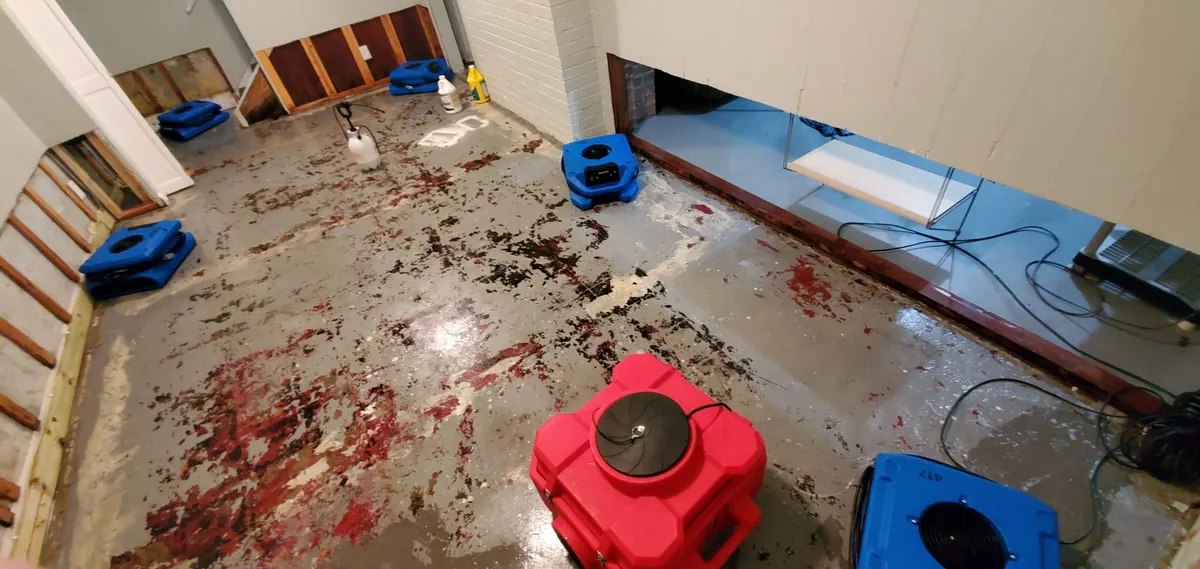
Then I pull out the sewage and the water, and I remove the porous materials that can’t be cleaned safely. My rule is simple, and it’s the same one you’ll hear from anyone who’s dealt with this: everything the sewage touched that isn’t metal or plastic goes. No guessing. After that I sanitize the area with professional antimicrobial products made for this level of contamination, and set up drying and dehumidification so mold doesn’t move in behind you.
I also document all of it. Photos, moisture readings, the works. If this is an insurance claim, that documentation is what protects you when the adjuster starts asking questions.
What drives the cost
Most people want a number, and I get it. The honest answer is that no two of these jobs are the same, so I won’t quote you one before I’ve seen it.
What moves the price is how far the sewage spread, how much porous material has to come out, and whether it reached framing or finished space instead of staying on a concrete floor. A contained backup around a basement floor drain is a different job from one that soaked a finished lower level. I walk the space, tell you what I’m seeing, and confirm the actual price with you on-site before I start any work.
Here’s what I’d tell you to watch on any estimate, mine or anyone else’s. Mitigation gets billed as line items: equipment on site, how many days it ran, materials removed. Ask for that itemized, then count the equipment against what’s actually sitting in your basement. I have seen estimates bill four dehumidifiers when two were running. If your adjuster’s number and the contractor’s number don’t match, the gap is usually in those line items rather than in the work itself. I document mine the way an adjuster needs it so there’s nothing left to argue about.
Waiting makes it worse, fast
Sewage damage doesn’t hold steady. Contamination keeps spreading, materials keep soaking, and mold can start growing within 24 to 48 hours. The sooner you call, the better this goes, both for your health and for what it ends up costing you.
Watch for a sewage smell, several drains running slow at once, or water coming up through floor drains or toilets. Those aren’t going to fix themselves. That’s the moment to call.
Where I work
I serve homeowners and businesses across Greater Cleveland, from the west-side suburbs out toward Lorain County and across the east side. If you’re not sure whether you’re in range, just ask.
When you need it handled
You shouldn’t have to deal with a sewage backup on your own. Use the callback form on any page here and it comes straight to me, day or night. Name and number is all I need to start. I’ll tell you straight what needs to happen, and I’ll get your home or business back to clean and safe as fast as I can.